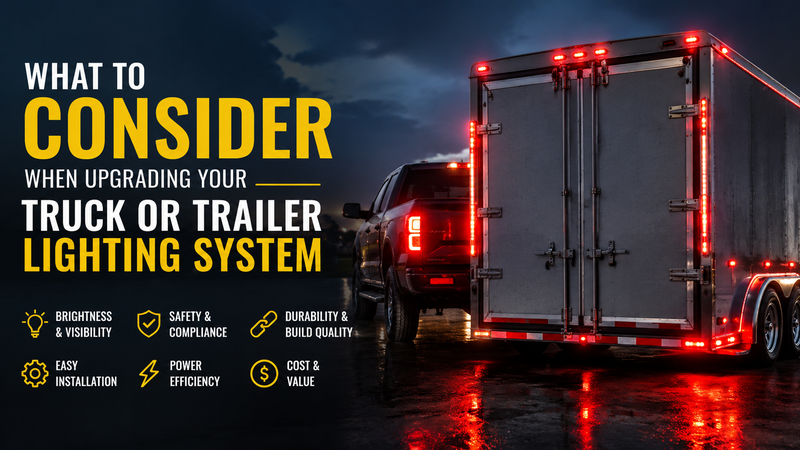
Upgrading your truck or trailer lights is not just a maintenance task. It is a serious decision with real consequences. The wrong choice costs you money, time, and sometimes compliance with the law. The right choice improves safety, reduces long-term costs, and keeps your vehicle inspection-ready. Thousands of Australian operators upgrade their lighting every year without fully understanding what they are buying. Many regret it within six months. If you are buying side marker lights from MaxiPARTS or any other supplier, there are specific things you need to know before you spend a dollar. This guide covers the decisions that actually matter.
What Kind of Lights Does Your Vehicle Actually Need?
Start with your vehicle’s legal requirements, not your preferences. Australian Design Rules (ADR) specify which lights are mandatory based on vehicle type, length, and width. Trucks over 7.5 meters in length require specific front and rear marker lights. Trailers over 7.5 meters need additional clearance lights. Heavy vehicles over 2.1 meters wide need side marker lights on each side. Ignoring these rules is not a gray area. It is non-compliance. A vehicle that fails its roadworthiness check due to lighting costs you time, money, and possibly a fine. Know your vehicle class and match your lighting to it.
Why Does the Light Housing Material Matter So Much?
The housing is what protects the light from the outside world. Trucks and trailers operate in rough environments. Gravel hits. Mud splashes. Vibration is constant. Cheap plastic housings crack within months. Low-quality seals let moisture in. Moisture kills electrical connections and corrodes the bulb socket. Look for housings rated IP67 or IP68. These ratings mean the unit is fully dust-tight and can survive submersion in water. Polycarbonate lenses are stronger than standard acrylic. Stainless steel mounting hardware resists rust. These are not premium extras. They are the minimum you should accept for a commercial vehicle operating in Australian conditions.
Is LED the Only Sensible Choice Right Now?
For most applications, yes. LED technology dominates the commercial vehicle lighting market for good reason. LED marker lights consume up to 80% less power than halogen equivalents. They last 30 to 50 times longer. They produce less heat. They handle vibration better because they have no filament to break. The upfront cost is higher. But over a 3-year operating period, LED systems consistently cost less than halogen due to reduced replacement frequency and lower power draw. The only scenario where halogen might make sense is an extremely old vehicle with an electrical system that cannot support LED compatibility. That is a rare case.
How Important Is Voltage Compatibility in a Truck Electrical System?
Very important. Trucks typically run on 24V systems. Passenger cars run on 12V. Trailers often pull power from the towing vehicle’s system. If you install a 12V light into a 24V system, it burns out immediately. If you install a 24V light into a 12V system, it does not illuminate properly. Some LED lights are dual-voltage compatible and handle both. These are worth finding. Always check the product specification before buying. A mismatch means a failed light at best and a wiring fire at worst. This is a real risk that kills electrical systems in older trucks and trailers.
What Does Vibration Resistance Actually Mean in Practice?
Trucks travel on rough roads. They vibrate constantly. That vibration works on every connection, every wire, every mount. A light that is not built for vibration will develop micro-fractures in its connections. Intermittent faults develop. The light flickers. Then it fails. LED lights have an inherent advantage here because they have no moving parts. But the housing and mounting design still matter. Look for rubber gaskets between the housing and the vehicle body. Look for spring-loaded or locking connectors on the wiring harness. A light rated to SAE J575 vibration standards is tested specifically for this environment. That rating is meaningful.
Should You Replace All Lights at Once or One at a Time?
Replace the full set at once when budget allows. Mixing old and new lights creates visible inconsistencies in brightness and color temperature. That looks unprofessional and can confuse other drivers about your vehicle’s dimensions. More practically, if one light has failed, the others in the same set are likely near the end of their life too. Replacing one today and three more over the next six months costs more in labor and downtime than doing the whole job at once. Fleet operators who batch replacements save an average of 20 to 30% on maintenance labor costs compared to reactive single-unit replacement.
What Makes a Supplier Actually Trustworthy?
A trustworthy supplier carries products with certifiable compliance documentation. ADR compliance for Australian roads is not optional. Ask for it. A good supplier can provide it immediately. They also offer technical support when you have installation questions. They carry replacement parts. They have warranty terms that are actually enforceable. The cheapest lights on a wholesale platform with no documentation and no warranty are not a deal. They are a liability. Pay a bit more for lights from a supplier who backs what they sell. Your vehicle’s roadworthiness and your operational reputation depend on it.Visit my site.