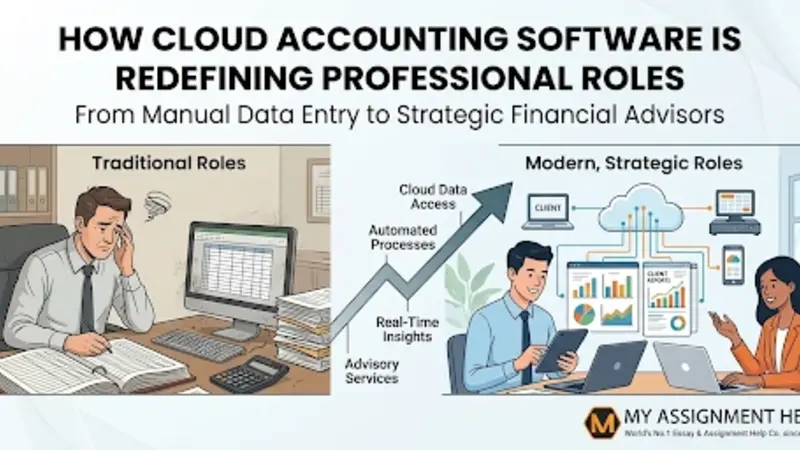
The traditional image of an accountant—buried under mountains of paper ledgers and manually entering rows of data into clunky desktop software—is rapidly becoming a relic of the past. As we move into 2026, the global cloud accounting market is projected to reach a staggering $7.32 billion, with North America holding over 50% of the market share. This shift isn’t just about moving data from a hard drive to a server; it is a fundamental re-engineering of the accounting profession itself.
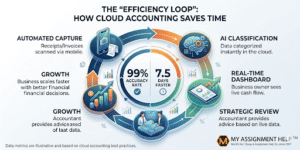
Cloud-native platforms like MYOB, QuickBooks, and Xero have evolved from simple record-keeping tools into interconnected financial ecosystems. For professionals in the United States, this transition has redefined the “standard” workday. Rather than spending hours on bank reconciliations and invoice matching, AI-driven automation now handles these routine tasks with up to 99% accuracy. This efficiency allows accountants to move away from the “back-office” and into the “boardroom,” acting as strategic advisors rather than historical record-keepers.
However, the learning curve for these sophisticated platforms can be steep for those still in the academic phase. Students pursuing finance degrees in the US often find that theoretical knowledge isn’t enough to master the practical nuances of cloud ecosystems. This is why many future professionals seek specialized MYOB assignment help to bridge the gap between classroom concepts and the real-world application of cloud-based accounting. Mastering these tools early is no longer an “extra credit” skill—it is a baseline requirement for employability in a tech-driven market.
The Strategic Shift: From Compliance to Advisory
The most significant impact of cloud technology is the democratization of real-time data. In the past, business owners looked at financial statements that were weeks or months old. Today, cloud dashboards provide live insights into cash flow, receivables, and tax liabilities.
This shift has changed the nature of professional roles in several key ways:
- The Rise of the “Finance Business Partner”: Accountants are no longer just “calculators.” They are now strategic partners who use predictive analytics to forecast cash flow and model growth scenarios.
- Automation of the “Boring Stuff”: According to recent industry reports, AI in the cloud can finalize monthly statements up to 7.5 days faster than traditional methods, freeing up nearly 10% of an accountant’s week for client-facing advisory work.
- Enhanced Data Security: With cyber threats becoming more sophisticated in 2026, cloud providers like AWS and Microsoft Azure offer enterprise-level encryption that on-premise servers simply cannot match.
For those looking to enter this high-stakes field, the academic pressure to perform is immense. Whether it’s mastering complex tax codes or learning to navigate the latest SaaS financial tools, students often require comprehensive assignment help usa to maintain their competitive edge. By leveraging professional support, students can focus on developing the soft skills—like critical thinking and strategic communication—that AI cannot replicate.
Key Takeaways
| Feature | Traditional Accounting | Cloud Accounting (2026) |
| Data Access | Localized (Office-only) | Global (Anywhere, anytime) |
| Reporting | Periodic/Historical | Real-time/Predictive |
| Primary Focus | Data Entry & Compliance | Strategy & Advisory |
| Accuracy | Prone to human error | AI-validated/High precision |
Key Skills for the 2026 Accountant
To thrive in this new landscape, US professionals must go beyond basic GAAP (Generally Accepted Accounting Principles) knowledge. The “Future-Proof” accountant needs:
- Technological Fluency: Comfort with AI-enabled platforms and API integrations.
- Data Analytics: The ability to interpret complex data sets and translate them into actionable business insights.
- Advisory Mindset: Moving from “what happened” to “what should we do next.”
- Soft Skills: High emotional intelligence for client relationship management, which remains the one area AI cannot touch.
FAQs
Q1: Will cloud accounting and AI replace human accountants?
No. While AI automates repetitive tasks like data entry, it lacks the ethical judgment, empathy, and strategic nuances required for high-level financial planning. The role is evolving, not disappearing.
Q2: What are the main benefits for small businesses in the US?
SMEs benefit from reduced IT overhead, as they no longer need to maintain expensive servers. They also gain access to real-time financial health monitoring, which is critical for survival in fast-moving markets.
Q3: Is my financial data safe in the cloud?
Yes. Major cloud accounting providers use multi-factor authentication (MFA), end-to-end encryption, and automated backups that typically exceed the security capabilities of a standard local business network.
Author Bio
Dr. Sarah Jenkins
Senior Academic Consultant at MyAssignmentHelp
With over 15 years of experience in financial auditing and academic strategy, Dr. Jenkins specializes in the intersection of Fintech and education. A former senior strategist, she now focuses on helping students in the US and UK navigate the complexities of modern accounting software through data-driven content and professional mentorship.
References:
- The Future of Accounting in 2026: Trends & Skills – The Richmond Group USA.
- Cloud Computing Market Size & Growth Report 2034 – Fortune Business Insights.
- AI in Accounting: Reshaping the Profession – Stanford Graduate School of Business.