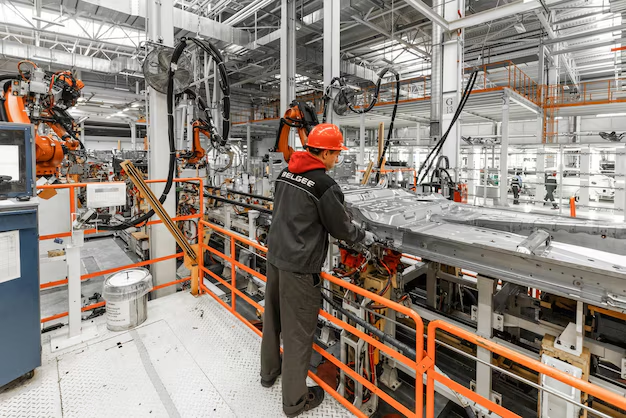
Modern industrial facilities are no longer defined by just machines and manpower. They are becoming intelligent ecosystems wherein precision, speed, and consistency define all such operations. As production demands continue to rise and downtime becomes increasingly expensive, businesses are turning to automation to stay competitive and efficient.
Automation of industries is not merely about the minimization of manual work. It is all about
creating smarter workflows, allowing faster decision-making, and attaining greater levels of operational performance. With advanced control systems and integrated robotics, automation is redefining how facilities operate daily and establishing new standards of reliability and scalability across industries.
To explore this change in more detail, the following are six ways that industrial automation is changing the way modern facilities work.
1. Minimize Downtime Through Predictive Maintenance
With the implementation of industrial automation, the maintenance approaches have changed to be predictive rather than reactive. Sensors on systems monitor the behavior of equipment and identify abnormal behavior before equipment breaks down. This enables you to take action early and prevent unforeseen breakdowns that halt operations.
Meanwhile, predictive maintenance allows you to organize service activities without distorting production schedules. Planned downtimes can be scheduled according to maintenance activities and minimize operational disruptions. Your facility, in turn, has a stable workflow with fewer disruptions.
In the long run, early solutions to problems can be used to maintain the state of important equipment. Components also work at lower stress levels, which minimizes wear and prolongs their lifespan. This results in reduced repair costs and improved system performance.
2. Enhance Production Efficiency with Smart Control Systems
Automation also brings control systems like PLCs that control processes with high accuracy. Every production phase is performed systematically so that each cycle has the same production volume. This leads to faster and more streamlined operations.
Besides, automated workflows minimize the likelihood of manual errors in repetitive activities. This uniformity enhances the quality of the product and reduces wastage during the manufacturing process. Over time, this results in more efficient use of resources without imposing any additional pressure on operations.
Another important benefit is the capability to modify processes in real time. Control systems react to the changing conditions and optimize the performance accordingly. This flexibility assists it in ensuring efficiency even where there are changes in production needs.
3. Improve System Reliability with Real-Time Monitoring and Diagnostics
Real-time monitoring provides continuous insight into system performance, allowing you to track operations as they happen. Due to the constant flow of data, it becomes far easier to detect inefficiencies. It allows making decisions much faster and helps to avoid small problems before they grow.
Equally significant, diagnostic tools contribute to isolating the problems with greater accuracy. Teams do not need to spend time conducting broad inspections, but instead can focus on the root cause. This minimizes downtime and enhances the rate at which issues are solved.
Regular check-ups also maintain the working of systems within specific parameters. When deviations are detected, alerts are issued to take immediate action to reestablish balance. This organized way of doing things enhances reliability and maintains the smooth running of operations.
4. Reduce Labor Dependency While Increasing Precision
Automation decreases the dependence on manual labor, particularly when performing repetitive and challenging work. These operations are conducted consistently by machines, which helps to maintain a consistent production output. It also enhances the safety of the workplace by reducing human contact with high-risk behaviors.
Simultaneously, automated systems provide a greater degree of accuracy than manual procedures. Activities are carried out using precise measurements and reproducible accuracy. This assists in the retention of product quality and minimizes the possibilities of defects.
By shifting away from manual work, you are able to redirect the workforce to other, more valuable duties. Workers may participate in monitoring, optimization, and refinement of the
processes of the system. It provides a more efficient and competent working atmosphere.
5. Build Flexible Production Lines with Custom Automation Solutions
Automation allows you to design production systems that match your specific operational requirements. Custom solutions ensure that processes are aligned with your facility’s workflow. This results in better efficiency and smoother operations.
In many cases, flexibility becomes essential when production demands change. Automated systems can be adjusted quickly to accommodate new products or processes. This helps reduce downtime and maintain continuity in operations.
As your facility grows, scalable automation supports expansion without major disruptions. Systems can be upgraded or extended without rebuilding the entire setup. It assists to ensure long-term adaptability while maintaining operational stability.
6. Strengthen Safety and Compliance Across Operations
Automation improves workplace safety by assigning hazardous tasks to machines instead of workers. This reduces the likelihood of accidents and creates a more controlled environment. As a result, overall safety standards improve across the facility.
Another important benefit is maintaining compliance with industry regulations. Automated systems follow predefined rules and execute tasks consistently. This minimizes the risk of non-compliance and simplifies regulatory processes.
Monitoring systems also help identify unsafe conditions in real time. Alerts notify teams immediately when risks arise, allowing for quick intervention. Thus, this proactive approach supports a safer and more secure operational setup.
Conclusion
Industrial automation continues to redefine how modern facilities operate by bringing greater control, consistency, and efficiency into daily processes. It enables you to reduce downtime, improve production accuracy, and maintain better visibility across systems.
At the same time, it supports flexibility, allowing operations to adjust to changing demands without significant disruption. As facilities grow more complex, automation provides the structure needed to manage performance effectively. By adopting these approaches, you can create operations that are not only efficient but also dependable and prepared for future challenges.