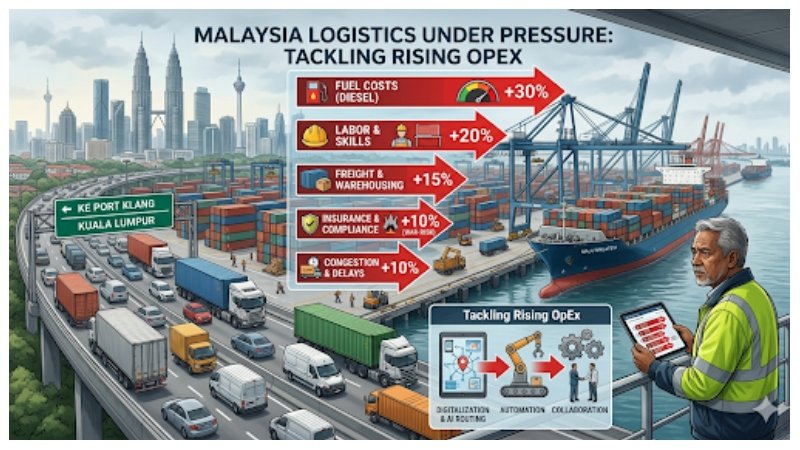
Margins are getting tighter, and Malaysia’s transport players are feeling it every day. From rising fuel bills to increasing labor and maintenance costs, operating a logistics business isn’t as straightforward as it used to be. What once worked with manual tracking, reactive decisions, and fragmented systems is now quietly eating into profits.
At the same time, the opportunity is massive. The value of Malaysia’s freight and logistics industry is estimated to be USD 29.7 billion in 2025 and is anticipated to be USD 40.11 billion by 2031 with a CAGR of approximately 5.14%. The demand is clearly there. But growth alone doesn’t guarantee profitability. The real challenge? Managing rising OpEx while keeping operations efficient, responsive, and scalable in an increasingly competitive landscape.
What’s Driving the OpEx Surge?
It’s not one problem; it’s a stack of pressures hitting all at once. Costs are rising from every direction, and for most operators, there’s very little room left to absorb them. What used to be manageable line items are now major cost centers, quietly eating into margins.
Fuel Price Volatility
Fuel remains the biggest cost lever and the most unpredictable one. For many operators, it accounts for nearly 25–35% of total OpEx. As of June 2024, the diesel subsidy rationalisation has caused prices to skyrocket from approximately RM 2.15 per litre to RM 3.35 per litre, an immediate ~55% increase. Although these prices were later adjusted (around RM 2.88/liter by early 2026), the transition to a market-based pricing system has brought about greater fluctuations in prices over the week. Planning costs have become a moving target.
Labor Shortages & Rising Wages
The lack of drivers is no new phenomenon, and it’s becoming a serious issue. The driver shortage in Malaysia is estimated to be around 35,000, with a significant aging population of drivers and low youth participation (approx ~6.5% under 25), and high entry barriers, including the costs of acquiring a driving license. The result? Growing wages, escalating overtime rates and reliance on a limited talent pool. It directly drives up transportation expenses en masse.
Maintenance and Aging Fleets
Older fleets come with hidden costs, frequent breakdowns, higher maintenance spend, and unplanned downtime. As margins tighten, many operators delay fleet upgrades, which only compounds the issue. It’s a cycle where trying to save money up front leads to higher long-term investment on the transport management system in Malaysia.
Regulatory and Compliance Costs
There can be no compliance without the costs; there can be no costs without compliance. Operators are confronted with various financial and administrative pressures, including tolls, which can represent 8-12% of line-haul costs on certain routes, and changes in the regulatory regime. These costs are not just felt immediately but can also mount up.
Fragmented Operations / Lack of Visibility
There are still numerous logistics operations not connected or using manual systems. Lack of visibility within fleets, routes and for each fuel type creates inefficiencies, idling time, sub-optimal routing and sub-optimal decision making. In the absence of real-time insights, small inefficiencies stack up over time, resulting in large cost leaks.
External Disruptions & Congestion Pressures
In addition to internal issues, there are external issues that are contributing to the cost. Port congestion is still an issue, with at Port Klang the yard utilisation rate above 90% and waiting times over 1 day for vessels. Logistics economics is also being affected indirectly on a global level by geopolitical tensions, resulting in rerouting risk and bunker fuel price increases in some instances as much as 140%.
Why Traditional Cost-Cutting Isn’t Working Anymore?
For years, the go-to move was simple cut costs wherever possible. Spend less, delay upgrades, push teams to do more with less. For then, it worked. However, the same is not true today, as now it’s becoming clear that this strategy can only go so far. The challenges facing today are more complex, and quick fixes aren’t enough anymore without taking the help of a cloud-based ERP.
Cutting Corners vs. Building Efficiency
Parting with corners may save money, but it may cause larger problems down the road. Short-term gain from avoiding upkeep and using too many resources on the same route or too many routes with the same resources is typically more expensive in the long run. It’s not about reducing the amount of money you spend; it’s about how you work with it.
Manual Processes Slowing Everything Down
Many logistics processes are still based on calling, manual documentation and spreadsheets. It’s very easy to start, and then it becomes more cumbersome as they increase. There are more and more errors that can be made, coordinating becomes more difficult, and teams spend more of their time fixing problems than they do preventing problems.
Reactive Decision-Making = Higher Long-Term Costs
When decisions are made only after something goes wrong, costs naturally go up. A delayed shipment, a vehicle breakdown, or wasted fuel, these aren’t just one-time issues. They keep repeating that there’s no system in place to catch them early.
The “Spreadsheet Ceiling” Problem
Spreadsheets are great until they’re not. They weren’t built for real-time tracking or complex operations. After a point, they just can’t keep up. And that’s when businesses start losing visibility, without even realizing where things are going wrong.
Inside Malaysia’s Transport Reality
- Strong demand, but not easy to manage: Malaysia runs on trade. Goods are constantly moving between ports, cities, and borders. But managing these flows smoothly isn’t always simple.
- Ports are busy, and delays are common: Major hubs like Port Klang are often running near full capacity. That means longer waiting times and slower turnarounds.
- Last-mile is where things get tricky: Urban traffic, tight delivery stop trip fraud and route confusion make the final stretch expensive and unpredictable.
- A market led by small operators: Most logistics businesses are SMEs. They’re agile, but often limited by budgets, tools, and older systems.
- More business, less breathing room: Demand is rising, especially with ecommerce. But costs are rising faster, so margins keep getting squeezed.
Conclusion
The era of managing operational costs the old way is definitely over; it will not work anymore in Malaysia’s rising transport sector, as costs continue to rise. We are not only talking about cutting costs, but also operating leaner and more effective systems that can adapt to continuous transformation. Those businesses that are on a different path, rethinking how to best manage fleets of vehicles and routes of data, can now feel the difference. Many remain on the back foot, reacting to problems as they occur.
FAQs
- Why is Malaysia’s transport sector suffering from a transport cost crisis?
There is an increasing cost burden on all fronts. The cost of fuel is variable, labour is becoming more expensive and maintenance costs are rising. Many operators have increasingly narrow margins these days.
- Why is fuel a big problem for logistics companies?
Fuel costs a considerable proportion of transport costs. If prices spike sharply, delivery and operating expenses are nearly instantaneously increased. There is a difficult budgeting process and lack of stable margins.
- Is there still a lot of manual work in the logistics sector?
Yes, there are still a lot of businesses using the old methods of spreadsheet, telephone, and manual tracking. It is suitable for smaller operations but the more demand there is, the more these systems slow the operation.
- What are some ways that technology can be used to lower the cost of operations?
Technology enhances sight & control. Fleet businesses can monitor fleets in real-time, optimize routes, minimize downtime and make faster decisions, made on the basis of real-time data.
- Which of the following is the reason why logistics companies are more concerned with efficiency today?
Just more deliveries are not enough any more. Businesses must decrease waste, minimize fuel usage, avoid delays and make better use of resources to remain profitable.
- What are the changes in Malaysia’s logistics industry in the future?
Industry digitalization and data-driven. As demand continues to grow, operators are making more investments into connected systems, smarter fleet management and automation to meet the need. Click here for more information.