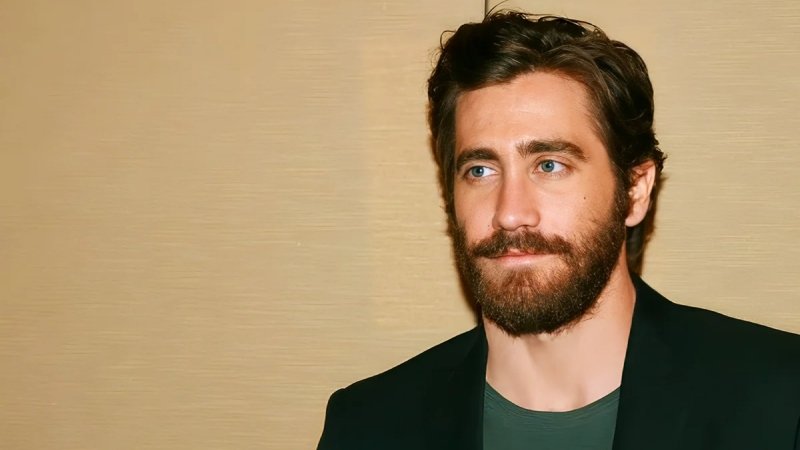
Jake Gyllenhaal has spent most of his life near cameras, scripts, directors, and public attention, but his career has never felt automatic. He could have become a comfortable Hollywood heir, the actor who grew up in the right rooms and stayed inside them. Instead, he built a career around risk, discomfort, and reinvention. He has played teenagers, soldiers, cowboys, detectives, boxers, ambulance drivers, comic-book villains, grieving husbands, and men whose inner lives seem one bad day away from collapse.
His appeal comes from a sharp contradiction. He can look like a traditional leading man, but many of his best performances work against that expectation. He often chooses characters who are charming at first, then strange, broken, obsessive, or dangerous. He does not simply disappear into roles through makeup or accent work. He changes his posture, his stare, his rhythm, and the way silence works around him.
Gyllenhaal was born Jacob Benjamin Gyllenhaal on December 19, 1980, in Los Angeles. His father, Stephen Gyllenhaal, is a director, and his mother, Naomi Foner, is a screenwriter. His older sister, Maggie Gyllenhaal, also became an actor. His first screen role came as a child in City Slickers in 1991, but his career did not turn into a straight line from child actor to adult star. His parents kept him close to ordinary work as well as film work, and he later spoke about jobs such as lifeguarding and working in restaurants during his youth.
That mix matters. Gyllenhaal grew up close enough to Hollywood to understand its machinery, but not far enough from normal life to lose all perspective. His background gave him access, but his choices gave him identity. The difference between those two things explains much of his career.
The Film-Set Childhood That Was Not as Simple as It Looked
Jake Gyllenhaal’s childhood is easy to describe badly. The lazy version says he was born into Hollywood and therefore became an actor. The fuller version is more interesting. He was raised by people who understood film as work, not glamour. His father directed. His mother wrote. His sister acted. Conversation, politics, performance, and storytelling were part of the family atmosphere.
That did not mean his parents treated acting as a casual inheritance. Gyllenhaal appeared early in films, including City Slickers, but his parents reportedly turned down some roles that would have taken him away from school or childhood for too long. The message was clear. Acting was allowed, but it was not allowed to swallow everything.
That boundary shaped him. Many child actors become known for one type of role and spend years trying to escape it. Gyllenhaal avoided that trap partly because he did not become too famous too young. He had time to observe before the public decided who he was.
His family also gave him a strong sense of artistic seriousness. Naomi Foner wrote character-driven work, including Running on Empty, while Stephen Gyllenhaal worked across film and television. Maggie Gyllenhaal later became known for roles that favored intelligence, restraint, and emotional complexity over easy stardom. Jake came from a family where acting was not just a route to fame. It was a craft with moral and emotional weight.
His first major breakthrough came with October Sky in 1999. He played Homer Hickam, a coal miner’s son in West Virginia who dreams of building rockets after seeing Sputnik cross the sky. The role worked because Gyllenhaal had a quality that felt sincere without being soft. He played ambition as something quiet and stubborn. Homer was not flashy. He was a boy trying to think beyond the town that had already planned his life.
October Sky gave Gyllenhaal his first real public identity: bright, earnest, sensitive, and capable of carrying a film. It also showed something that would return in later roles. He is often strongest when playing people caught between expectation and private hunger. Homer wants a future that looks impossible. Many later Gyllenhaal characters want something just as badly, but their desires become darker.
The Strange Boy Era, From October Sky to Donnie Darko
Gyllenhaal’s early career changed shape with Donnie Darko. Released in 2001, the film did not become a giant hit right away, but it grew into a cult favorite. Gyllenhaal played Donnie, a troubled teenager who sees a frightening figure in a rabbit suit and becomes tangled in questions of time, fate, mental illness, and suburban dread.
The performance worked because he did not play Donnie as simply “weird.” He gave him intelligence, irritation, humor, loneliness, and menace. Donnie could be tender with one person and cruel to another. He could look fragile in one scene and almost frightening in the next. Gyllenhaal understood that adolescence can feel like an unstable chemical reaction. He used that instability as the center of the role.
The film also paired him with his sister Maggie, who played his onscreen sister. Their scenes together had a natural rhythm because they did not need to force sibling energy. They already understood how to interrupt, challenge, and irritate each other without making it look theatrical.
Donnie Darko also created a public association that followed Gyllenhaal for years. He became linked with outsiders, dreamers, disturbed young men, and characters who do not fully belong in the world around them. That could have trapped him. Instead, he used it as a starting point.
After Donnie Darko, he moved through different kinds of young-man roles. In The Good Girl, he played Holden Worther, a restless and emotionally needy store employee opposite Jennifer Aniston. In Moonlight Mile, he played a young man grieving a fiancée whose death has left him trapped inside another family’s sorrow. These roles did not make him a conventional movie star, but they sharpened his screen identity. He could play vulnerability without turning it into sweetness. He could make discomfort watchable.
That period also showed his gift for internal pressure. Some actors show emotion by pushing it outward. Gyllenhaal often does the opposite. He lets the pressure sit behind the eyes. He makes the viewer wait for the moment when the character will crack, speak, lie, run, or explode.
That quality became central to his best adult work.
The Romantic, the Soldier, the Cowboy, the Obsessive
Gyllenhaal’s move into adulthood did not follow one clean path. He tested several versions of himself. He appeared in blockbuster disaster cinema, intimate drama, war satire, romance, and crime investigation. The result was not always tidy, but it helped him avoid becoming one thing too early.
In The Day After Tomorrow, he entered large-scale studio filmmaking. The movie placed him in a global climate disaster story, giving him mainstream visibility. It was not his most complex role, but it mattered commercially. It proved he could exist inside a big Hollywood machine without losing his presence.
Then came Jarhead in 2005. Directed by Sam Mendes, the film followed U.S. Marines during the Gulf War. Gyllenhaal played Anthony Swofford, a young man trained for combat but stranded in boredom, heat, anxiety, and military absurdity. The film did not treat war as constant action. It treated it as waiting, frustration, identity loss, and masculine performance. Gyllenhaal captured the strange emptiness of a man prepared for violence but denied a clear purpose.
The same year, Brokeback Mountain changed his career. He played Jack Twist opposite Heath Ledger’s Ennis Del Mar. The film followed two men whose love begins during a summer of sheep herding and continues through years of secrecy, longing, fear, and damage. Gyllenhaal’s Jack is more open than Ennis, more willing to imagine a life together, but also trapped by the same social violence. The role earned Gyllenhaal an Academy Award nomination for supporting actor and remains one of the defining performances of his career.
Jack Twist could have been played as pure yearning. Gyllenhaal makes him more complicated. Jack is romantic, but also impatient. He wants tenderness, but he also wants escape. He lies, performs, pushes, and waits. His tragedy is not only that he loves Ennis. It is that he can see a version of life that Ennis cannot allow himself to choose.
After Brokeback Mountain, Gyllenhaal made another sharp turn with Zodiac. David Fincher’s 2007 film followed the obsession surrounding the Zodiac killer case. Gyllenhaal played Robert Graysmith, a cartoonist who becomes consumed by the mystery. The film is patient, procedural, and quietly suffocating. Gyllenhaal’s performance builds through small changes. At first, Graysmith seems curious and slightly awkward. Later, that curiosity hardens into fixation.
Zodiac became one of the clearest examples of Gyllenhaal’s interest in obsession. He is drawn to characters who follow a thread too far. They want answers, justice, fame, love, proof, or control. Once they start pulling, they cannot stop.
The Body as a Tool, When Gyllenhaal Started Transforming
Gyllenhaal’s later career became more physical, but not in the simple action-star sense. He began using his body as part of the character’s psychology. Weight, muscle, movement, sleep deprivation, facial tension, and posture all became part of the work.
End of Watch gave him one of his strongest grounded performances. He played Brian Taylor, an LAPD officer working with Mike Zavala, played by Michael Peña. The film depends on the bond between the two men. Gyllenhaal and Peña trained with police officers and built a convincing rhythm as partners. Their scenes in the patrol car have speed, teasing, loyalty, and dread. The film works because the friendship feels lived-in before the danger arrives.
Then came Prisoners, directed by Denis Villeneuve. Gyllenhaal played Detective Loki, a controlled investigator searching for two missing girls. Hugh Jackman’s character shows grief through rage. Gyllenhaal’s Loki shows pressure through restraint, blinking, stillness, and clipped movement. He gives the detective small habits that make him memorable without explaining him too much.
His collaboration with Villeneuve continued with Enemy, where he played two roles: a professor and an actor who appear to be exact doubles. The film is cryptic, tense, and strange. Gyllenhaal later discussed the challenge of acting opposite himself and the technical and emotional demands of that work.
The most extreme example of his transformation came with Nightcrawler in 2014. Gyllenhaal played Lou Bloom, a freelance crime videographer in Los Angeles who records accidents, violence, and death for local news. Lou is polite, articulate, ambitious, and empty. He speaks in business clichés and self-improvement language, but there is no moral center behind the words.
Gyllenhaal lost weight for the role, giving Lou a hungry, nocturnal look. His eyes seem too large for his face. His smile arrives at the wrong time. He moves like a man who has studied humans but never joined them. Nightcrawler may be his most disturbing performance because Lou does not break down. He improves. The more ruthless he becomes, the more the world rewards him.
The role also turned Gyllenhaal into a sharper cultural figure. Lou Bloom was not just a villain. He was a product of hustle culture, media hunger, and moral vacancy. He spoke the language of ambition with no sense of responsibility. Gyllenhaal understood that horror and made it calm.
In Southpaw, he moved in the opposite physical direction. He played Billy Hope, a boxer whose life collapses after personal tragedy. Gyllenhaal trained intensely for the role and built the body of a fighter. The film itself follows familiar sports-drama beats, but his commitment gives the character weight. Billy’s pain is blunt, physical, and messy.
Stronger required a different kind of responsibility. Gyllenhaal played Jeff Bauman, who lost both legs in the Boston Marathon bombing. The role demanded care because Bauman is a real person, not a symbolic figure. Gyllenhaal avoided turning him into a simple inspirational character. He played trauma as difficult, angry, loving, selfish, scared, and human.
His action work later widened with films such as Ambulance and Road House. These roles showed another side of him: intense, fast-talking, physically present, and willing to lean into entertainment without treating it as beneath him. That balance has become part of his modern career. He can move from serious drama to commercial action without seeming lost in either place.
The Stage, the Risks, and the Odd Choices
Gyllenhaal’s film career gets most of the attention, but his stage work matters. Theater strips away editing, close-ups, and second takes. For an actor known for intensity, stage work can either expose technique or deepen it. Gyllenhaal has returned to the stage several times, including work in This Is Our Youth, Constellations, Sunday in the Park with George, and Sea Wall/A Life. His Broadway work has earned serious recognition, including Tony attention for Sea Wall/A Life.
Theater also fits his career pattern. He seems drawn to work that tests control. On stage, an actor cannot depend on the camera to find the right angle or the editor to select the best moment. The performance must live in real time. Gyllenhaal’s best screen acting often feels tightly wound, and theater gives that tension a direct outlet.
His risky film choices also separate him from many actors of his generation. He has not always chosen the obvious prestige path. Enemy was surreal and unsettling. Okja let him play an exaggerated television zoologist with nervous energy and theatrical absurdity. Velvet Buzzsaw placed him inside a satirical art-world horror story. The Sisters Brothers put him in a strange, mournful Western beside Joaquin Phoenix, John C. Reilly, and Riz Ahmed.
Not every choice worked equally well. That is part of the point. Gyllenhaal’s career is interesting because it includes misfires, odd turns, and experiments. He does not protect his image as carefully as some leading men. He is willing to look foolish, cruel, weak, strange, or unpleasant.
That willingness gives his career texture. A safer actor might have followed Brokeback Mountain with a long run of handsome dramatic leads. Gyllenhaal kept swerving. He played a prince in Prince of Persia: The Sands of Time, then moved toward darker material. He joined the Marvel universe as Mysterio in Spider-Man: Far From Home, but even that role fit his interest in performance, deception, and unstable charm. Quentin Beck is a showman pretending to be a hero. That is very much a Gyllenhaal kind of mask.
His lesser-known details also add to the picture. He has spoken about being legally blind without corrective lenses and described that condition as something he has learned to use in acting. Reports note that he has worn corrective lenses since childhood, and he has discussed using limited vision during emotional work, including while filming Southpaw.
That fact is not trivia for trivia’s sake. It connects to his acting style. Gyllenhaal often plays on perception as unstable. His characters look hard at the world, but they may not see it clearly. Donnie Darko sees too much or not enough. Robert Graysmith sees patterns that consume him. Lou Bloom sees opportunity where others see suffering. Detective Loki sees clues but cannot fully control the case. The idea of vision, literal and moral, runs through his work.
He also has unusual Hollywood connections. Paul Newman was his godfather, and Jamie Lee Curtis is his godmother. He is also the godfather of Matilda Ledger, the daughter of Heath Ledger and Michelle Williams, his Brokeback Mountain co-stars. These details show how deeply his life has been tied to film culture, but they also underline the personal bonds behind some of his most famous work.
One striking story from his personal life came in 2006, when he and Maggie Gyllenhaal escaped a fire at Manka’s Inverness Lodge in California. Reports from that event described guests fleeing after a tree fell and sparked the blaze, with Gyllenhaal helping pull items from the fire. It is the kind of story that sounds almost cinematic, but it belongs to the offscreen life of someone usually discussed through roles and premieres.
The Stories Behind the Stare, and Why He Still Holds Attention
Jake Gyllenhaal’s career has lasted because he understands the value of tension. He rarely plays people who are fully settled. Even when a character appears confident, something underneath is usually working against him. That inner conflict gives his performances their charge.
His face helps, but not in the simple movie-star way. He has the features of a leading man, yet he often uses them to create unease. His eyes can suggest warmth, calculation, panic, or emptiness. His smile can feel charming in one film and threatening in another. He knows how to make the same expression mean different things depending on the character.
His voice also shifts in interesting ways. In Nightcrawler, Lou Bloom speaks with artificial precision, as though he learned conversation from online business courses. In Brokeback Mountain, Jack Twist speaks with more openness and strain. In Prisoners, Detective Loki keeps his words tight. In Ambulance, Danny Sharp talks quickly, pushing energy into every scene. Gyllenhaal does not rely on one signature rhythm.
His best roles also reveal a pattern in American masculinity. He often plays men under pressure from systems they cannot fully control: family, war, crime, media, class, ambition, trauma, fame, or violence. Some of these men are victims. Some are predators. Some are both. He does not always ask the audience to like them. He asks the audience to stay close enough to understand the pressure.
That is why his career can hold both Jack Twist and Lou Bloom. Jack wants love in a world that punishes it. Lou wants success in a world that rewards moral emptiness. Both characters are shaped by desire. One breaks the heart. The other chills it.
Gyllenhaal’s career also reflects a rare kind of patience. He became famous young, but his most interesting work did not arrive all at once. He built it over time. October Sky showed promise. Donnie Darko gave him cult status. Brokeback Mountain gave him prestige. Zodiac gave him adult seriousness. Nightcrawler gave him danger. His stage work gave him another dimension. His action roles gave him renewed commercial reach.
He has also managed privacy better than many actors who came of age in tabloid culture. His relationships have often drawn attention, but he rarely lets celebrity gossip define his public identity. He tends to bring attention back to the work, the preparation, and the directors he chooses.
That does not make him mysterious in a manufactured way. It makes him selective. He gives enough to promote a film, but not so much that every role becomes buried under personal branding. In an era when many performers are expected to be constantly available online, Gyllenhaal has preserved some distance.
That distance helps the work. The less the audience feels it knows everything about him, the easier it is to believe the next character. He can still surprise viewers because he has not fully flattened himself into a public personality.
His career is not perfect, and that is another reason it remains alive. Perfect careers can become dull. Gyllenhaal has taken roles that divided audiences. He has appeared in films that did not match his performance. He has made choices that looked strange on paper and stayed strange on screen. Yet those choices show appetite. He still seems interested in the risk of acting, not just the reward.
A useful way to understand him is to think of him as an actor who keeps changing rooms. He began in the family room of Hollywood, surrounded by writers and directors. He moved into teenage bedrooms filled with fear and confusion. He entered military barracks, mountain camps, police cars, news vans, boxing gyms, hospital rooms, Broadway stages, superhero illusions, and emergency vehicles racing through Los Angeles. Some of those rooms had restaurant booths, some had interrogation tables, some had no comfort at all. In each one, he looked for the pressure point.
That search defines him better than any single role. Gyllenhaal is not just the sensitive young actor from October Sky, the cult figure from Donnie Darko, the romantic tragedy of Brokeback Mountain, or the hollow-eyed predator of Nightcrawler. He is all of those versions, plus the restless worker underneath them.
His best performances leave a mark because they do not settle too quickly. They keep the viewer slightly alert. Something in the character may be hidden, injured, false, or about to turn. Gyllenhaal understands that people are often most revealing when they are trying not to reveal anything.
That is why he remains one of the most watchable actors of his generation. He has a movie-star presence, but he keeps contaminating it with doubt, hunger, anger, grief, and oddness. He can carry a mainstream film, then slip into a role that makes the audience uncomfortable. He can play charm and corrosion in the same breath.
Jake Gyllenhaal’s story is not simply a rise from Hollywood childhood to adult fame. It is the story of an actor who keeps resisting the easiest version of himself. He was born near the center of the film industry, but his career has been strongest when he steps toward the edge.