Most childcare models tell children what to learn and when. Reggio Emilia flips that. Developed in post-war Italy by educator Loris Malaguzzi in the 1940s, this approach treats children as capable, curious, and full of ideas worth exploring. It is now used in over 90 countries. Research from the University of Massachusetts found Reggio-inspired programs produce stronger critical thinking and creative problem-solving outcomes than traditional models. If you want your child to think, not just memorise, understanding Reggio Emilia childcare is worth your time.
What Is the Core Idea Behind the Reggio Emilia Approach?
The core idea is simple. Children learn best when they drive their own learning. Malaguzzi called this the ‘image of the child.’ He believed every child comes into the world with enormous potential. The educator’s job is to listen, observe, and build on what the child already brings. This is the opposite of a teacher standing at the front of a room delivering content. In Reggio settings, the room itself is called the ‘third teacher.’ The child, the educator, and the environment all teach together.
How Does the Environment Function as a Teacher?
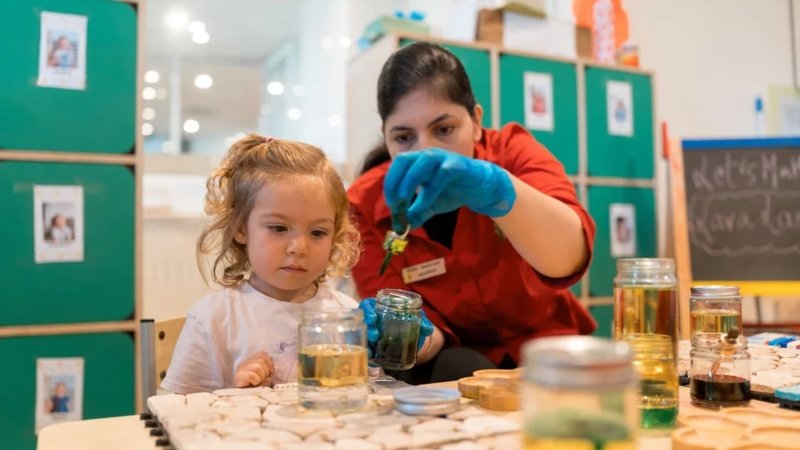
Reggio classrooms are intentionally beautiful. Materials are organised, visible, and accessible. Natural objects sit alongside art supplies and scientific tools. Children can reach everything themselves. This matters because autonomy builds confidence. A 2019 study in Early Childhood Education Journal found children in intentionally designed Reggio environments showed 34% higher initiative in problem-solving tasks compared to those in standard classrooms. The layout communicates trust. It says: you can do this yourself.
Why Is Documentation Central to This Approach?
Educators in Reggio settings document everything. Photos, voice recordings, drawings, written observations. This is not about creating a portfolio for parents. It is a teaching tool. When educators revisit documentation with children, children reflect on their own thinking. That metacognitive loop, thinking about your own thinking, is one of the strongest predictors of academic success. Cognitive science research from Stanford confirms that children who can explain their own reasoning outperform peers in both literacy and numeracy by age seven.
What Are the ‘Hundred Languages of Children’?
Malaguzzi wrote that children have a hundred ways of expressing themselves. Movement, drawing, building, singing, sculpting, storytelling. Traditional schooling cuts most of these down to two: talking and writing. Reggio does not do that. When a child builds a structure out of blocks, they are working through spatial reasoning. When they paint their feelings, they are processing emotion. Each ‘language’ unlocks a different part of the brain. Limiting expression limits learning.
How Does Project-Based Learning Work in Reggio Settings?
Projects in Reggio classrooms are not assigned. They emerge from children’s interests. A group becomes fascinated by shadows. The educator notices this and builds an investigation. Children experiment with light sources. They draw what they see. They argue about why shadows change shape. This can last days or weeks. Long-form projects develop persistence, cooperation, and deep understanding. A University of Chicago study found project-based learners retained knowledge 40% longer than those taught through direct instruction.
Does Reggio Emilia Work for All Children?
The evidence says yes, including children with developmental differences. The approach’s flexibility means it adapts to the individual. A child with sensory sensitivities can engage through hands-on materials rather than group discussion. A child who is verbal and social can lead group investigations. Because Reggio does not set a fixed curriculum timeline, children are not labelled as behind. They are simply at a different point in their exploration. That framing removes shame and preserves motivation.
What Role Do Parents Play in a Reggio Childcare Setting?
Parents are partners, not passive observers. Reggio philosophy calls families the first teachers. Centres share documentation regularly. Families contribute their cultural knowledge, stories, and skills. Parent evenings are common. So are collaborative projects where families and children work together. This connection between home and centre matters. Harvard’s 30 Million Words Initiative found children whose families were actively involved in early learning had vocabularies twice as large at age three compared to those whose families were not engaged.
Why Is This Approach Growing in Australia?
Australia’s National Quality Standard already aligns well with Reggio principles, particularly Quality Area 1, which focuses on educational programming and practice. Many leading Australian early learning centres have adopted Reggio as their primary framework. Families are choosing it because results are visible. Children from Reggio-inspired programs enter primary school with stronger self-regulation, richer vocabulary, and greater curiosity. These are not soft skills. They are the foundation of every academic outcome that follows.